Transducers, gauges, sensors - Information portal © 2011 - 2025 Use of material is possible by placing an active link
Home >> Publication >> Semiconductor measuring transducers.. temperature, strain gauge...
русский / english
• Information about various converters and sensors of physical quantities, parameters of various physical processes is presented.
• Electrophysical properties and effects in various electrical materials.
• Theory, experimental results, practical application
Semiconductor measuring transducers of deformation, temperature and magnetic-field for application in the conditions of radiation irradiation, wide range of temperatures and magnetic fields
(Full text: V.A Belyakov, N.T.Gorbachuk, P.A.Didenko, E.A. Lamzin, etc. Semiconductor measuring converters of deformation, temperature and magnetic field for application in conditions of a radiating irradiation, wide range of temperatures and magnetic fields. Questions of the nuclear science and technics. A series: the electrophysical equipment. 3 (29), 2005. St. Petersburg, Russia.)
Abridged version of the article: Semiconductor Sensors
Semiconductor materials possess a high sensitiveness to different external influences and at development on their basis of measuring transducers (sensors) of physical sizes /15/ aim to use such materials and construction of pickoff, that a transducer maximally reacted on a measureable parameter and scorned small on other. In connection with development of criogenics technique, atomic energy demand grows on transducers are capable of working in the range of temperatures from climatic to cryogenics, magnetic fields to 10 Тл and possessing radiation stability /1,4/.
In modern sensors of creation semiconductor material is used as a rule in a pellicle kind, advantages of which consist in possibilities of the use of integral technologies, creations of cerouss of transducers with identical descriptions, more subzero cost of the got pickoffs of and other
By us for creation of measuring transducers tapes of gaas are used on a semiinsulating gaas, tapes of polisilicon on linings from silicon, tapes of germanium on linings from a gaas, and also by volume dispersible germanium. Researches are conducted in the range of temperatures 4.2-400 К.
1. Measuring transducers of mechanical deformations
At measuring of mechanical deformations by means of single strain gauge in the wide range of temperatures, in the conditions of the difficultly tense states of object, in presence the magnetic fields, exactness of measuring considerably goes /down 2,3/. New possibilities in the increase of exactness of measuring are opened by the use of tapes on insulating bases, when a pickoff is formed as a certain microcircuit of crystallgraphicly by oriented, and the construction of transducers allows to remove transversal strainsensetivity /4,5/.
To create measuring transducers of mechanical deformation, polysilicon films of n- and p-type conductivity, 0.6 µm thick and doping levels of 10^17 - 5·10^19 cm-3, were used. Boron served as a dopant for p-silicon.
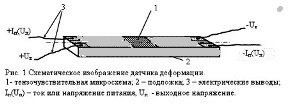
Figure 1 shows a schematic representation of the strain gauge transducer and the polarity of the power supply and measuring instruments. It consists of an integrated sensing element 1, made from a silicon film deposited on a substrate 2 made of monocrystalline silicon with an oxide layer on the surface. Electrical terminals 3 are made of aluminum wire with a diameter of 80 µm, the ends of which are equipped with strips of metal suitable for soldering with standard solder. The design and integral implementation of the sensor's sensing element provide thermal compensation of the main parameters, compensation for the influence of the magnetic field, and the absence of transverse strain sensitivity. The sensor base size is 8 mm, the input and output electrical resistances, depending on the doping level and film thickness, range from 200 to 3000 ohms, and the supply current depends on the resistance value and is typically in the range of 1 to 10 mA.
The operating principle of a strain gauge sensor is based on the change in electrical resistance of the resistive elements of an integrated circuit when mechanical deformation is applied along the sensor axis, decompensating the chip and causing an electrical voltage Uv to appear across the measuring contacts when the sensor is supplied with current or voltage (see Fig. 1). After pre-calibrating the sensor, i.e., obtaining the dependence of the output voltage Uv on the magnitude of the mechanical deformation e, the deformation of the object is then determined from the output voltage of the sensor, which is rigidly attached to the object.
When determining the strain gauge coefficient, the sign of the compressive deformation is assumed to be negative, and this is taken into account in the sensor specifications.
- 1 -


See also:
CONVERTERS, GAUGES, SENSORS
Information, news, advertising