
Transducers, gauges, sensors - Information portal © 2011 - 2025 Use of material is possible by placing an active link
Calibrating of thermocouple (calibration charts)
For a condition, when a free end(shut) of thermocouple is at the zero of degrees celsius. A temperature is driven to °C, E.M.F. (tension) in mV.
chromel - alumel (-270 °с to 1370 °с)
(0 °с to 1820 °с)
chromel - constantan (-260 °с to 1000 °с)
copper - constantan (-270 °с to 400 °с)
chromel - kopel (-20 to 200 °с)
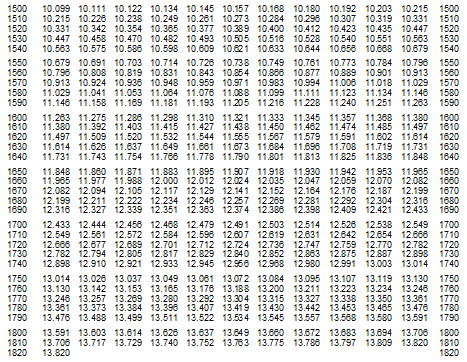
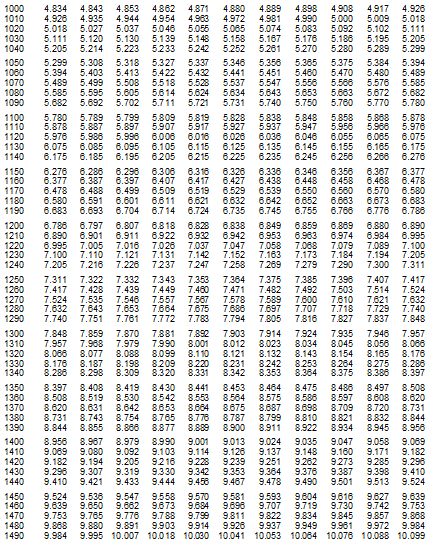
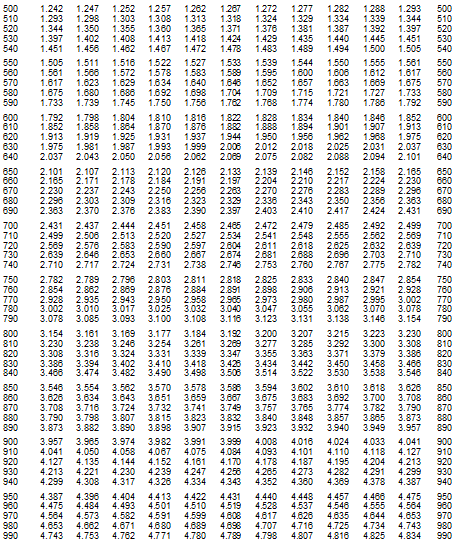
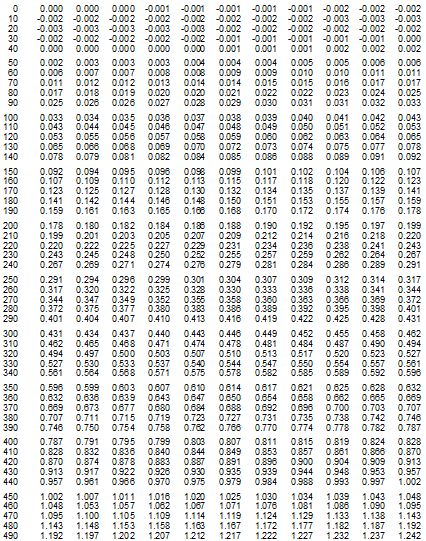
Calibrating (calibration charts) of thermocouple : platinum-30% rhodium/platinum-6% rhodium (Type B)
Range of temperatures from 0 C to 1820 °C
For a condition, when a free end(shut) of thermocouple is at the zero of degrees celsius
Home >> Temperature, thermoelectricity >> Thermocouple platinum-30% rhodium/platinum-6% rhodium
русский / english
• Information about various converters and sensors of physical quantities, parameters of various physical processes is presented.
• Electrophysical properties and effects in various electrical materials.
• Theory, experimental results, practical application


See also:
CONVERTERS, GAUGES, SENSORS
Information, news, advertising
Platinum-rhodium thermocouples (TRP) are primarily used to measure extremely high temperatures (600 - 1800°C). These thermocouples are considered high-precision sensors. Their main advantage is their resistance to oxidation and, consequently, stable characteristics.
They are used to measure the temperature of molten metals and monitor the operation of smelting furnaces, in glass and ceramic production, and elsewhere (for example, to diagnose furnace operating conditions and measure the temperature of glass melts in furnaces). Platinum-rhodium thermocouples are also used in the aerospace industry and chemical laboratories. They are often used for the precise calibration of other temperature measurement devices (sensors).